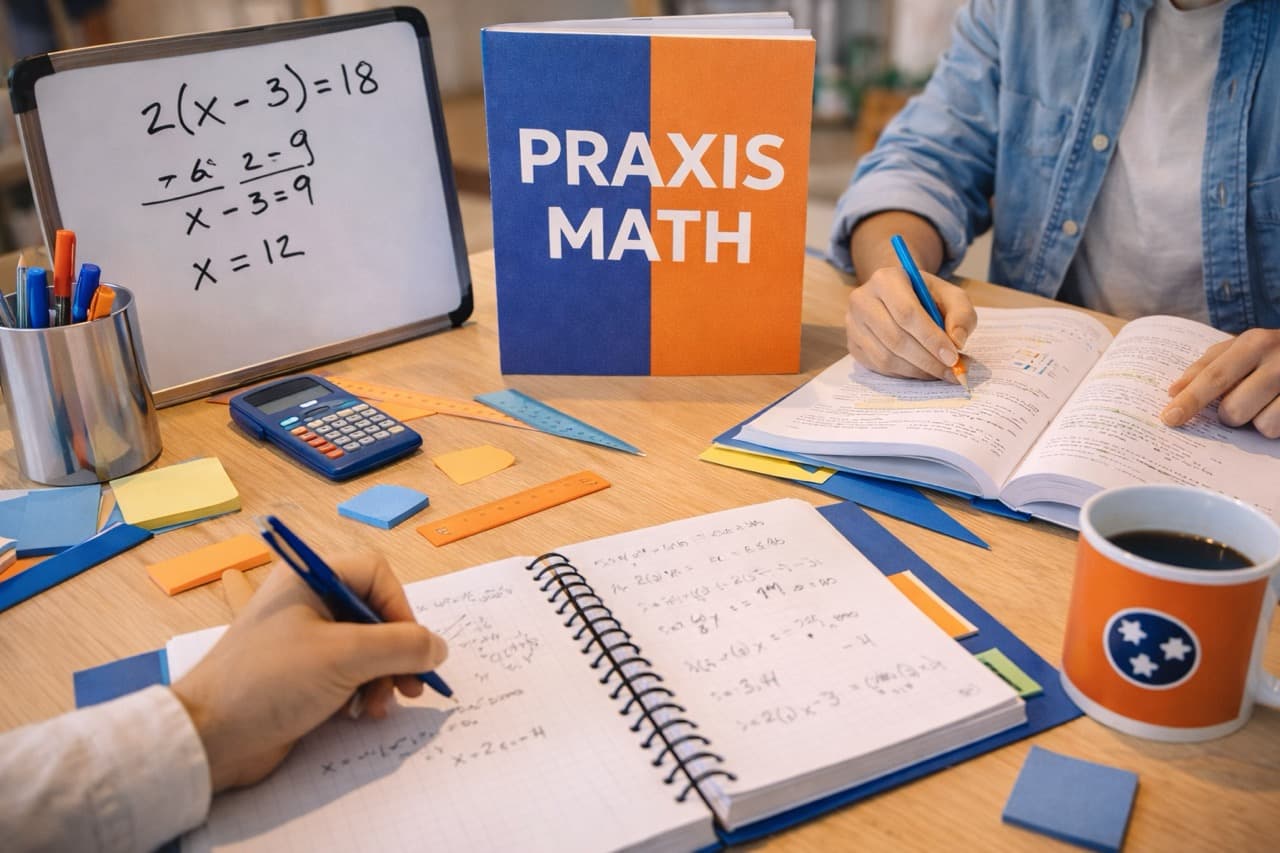
Let's be real: math is the reason most people fail the Praxis. Not reading. Not writing. Math. And if you're here right now, you probably already know that gut-punch feeling of seeing a score that's just a few points short. Maybe you've been through it more than once.
Here's what nobody tells you about how to pass praxis math: it's not about relearning algebra or drilling hundreds of practice problems. The people who keep failing usually know the math just fine. What they don't know is how to take this specific test. And yeah, there's a massive difference.
In this guide, we're breaking down every math Praxis exam - from the elementary 5003 to the content knowledge 5165 to the Praxis Core math - with specific strategies that actually move your score. No fluff, no generic "study harder" advice. Just the stuff that works.
Why the Math Praxis Is Different from Any Math Test You've Taken
You've taken hundreds of math tests in your life. Quizzes in high school, exams in college, maybe standardized tests like the SAT or GRE. So why does the Praxis math feel so much harder?
Because ETS isn't testing whether you can solve math problems. They're testing whether you can solve their math problems, in their format, under their time constraints. And those constraints are designed to trip you up in very specific ways.
- Questions use unfamiliar phrasing that makes simple concepts look complex
- Multiple answer choices are mathematically close - designed to catch calculation errors
- Word problems bury the actual question under layers of irrelevant context
- Time pressure forces you to rush, which leads to careless mistakes on problems you actually know
- The format rewards test-taking skill as much as mathematical knowledge
Think about it this way: your college professor wanted you to show your work and demonstrate understanding. ETS wants you to pick the right letter in 90 seconds. Completely different skill set. And if you've been studying by reviewing content and doing practice problems the "normal" way... you've been training for the wrong game.
The best way to study for math praxis isn't more math. It's better strategy. That's the fundamental shift that separates people who pass from people who keep failing.
Which Math Praxis Do You Need?
Before we dive into strategies, let's clear up the confusion about exam codes. There are several different "math Praxis" exams, and the one you need depends on what you're trying to teach and where.
Praxis Core Math (5733)
The general skills exam required for many teacher certification programs. Tests basic math - arithmetic, algebra, geometry, data analysis, and probability. 56 questions in 85 minutes. This is part of the Praxis Core Academic Skills battery.
Praxis Elementary Education Math (5003)
One of the four subtests of the Praxis Elementary Education exam (5001). Covers number sense, algebra, geometry, measurement, and data analysis at an elementary level. About 50 questions in 65 minutes.
Praxis Math Content Knowledge (5165)
For aspiring secondary math teachers (grades 7-12). This is the deep one - algebra, geometry, trigonometry, calculus, statistics, probability, and discrete math. About 60 questions in 150 minutes. Required by most states for math teacher certification.
Praxis Middle School Math (5164)
For middle school math certification. Covers arithmetic through pre-algebra and basic geometry. It's a step above Core but not as intense as 5165. Roughly 55 questions in 130 minutes.
Praxis Math 5161 / 7813
Older or state-specific exam codes you might see referenced. The 5161 is being replaced by 5165 in most states, and 7813 is a state-specific variant. Check your state's requirements - the strategies we cover here work across all codes.
Not sure which exam you need? Your state's Department of Education website will have the exact list. And honestly, the core strategies we teach apply to all of these. The test-taking patterns ETS uses are remarkably consistent across exam codes.
Is the Praxis Math Hard?
We hear this question constantly. And the honest answer is: it depends on how you're preparing.
The praxis math pass rate tells a sobering story. Depending on the exam, somewhere between 25-35% of test-takers fail on their first attempt. Math exams consistently have the lowest pass rates of any Praxis category. So statistically? Yeah, it's hard.
But here's the thing most people miss: the difficulty isn't about complex math. Praxis Core Math doesn't go beyond what you learned in high school. Even the content knowledge 5165, while more advanced, tests concepts you covered in your degree program. The difficulty comes from how they test it.
Why Smart People Fail the Math Praxis
- • Math anxiety - freezing up under pressure, even on problems you'd solve easily at home
- • Time mismanagement - spending 5 minutes on one hard question and rushing through 10 easy ones
- • Overthinking - reading too deeply into straightforward questions because "it can't be that simple"
- • Wrong prep method - reviewing content instead of practicing test strategy
- • Calculator dependence - reaching for the calculator when estimation would be faster and more accurate
The people who pass? They don't necessarily know more math. They know how to take this specific test. And that's a learnable skill - one we teach in 48 hours.
Praxis Math Passing Scores by Exam
Knowing the math praxis passing score you need takes some of the mystery (and anxiety) out of the equation. Here's a general overview - but remember, your state may have different cutoff scores.
States like New Jersey tend to have higher required scores, while others are more lenient. The praxis core math passing score varies quite a bit - some states accept 142, others want 150 or higher. Always verify with your specific state board.
Here's what matters: the Praxis uses scaled scoring, not simple percentages. You don't need to get every question right. For most exams, getting roughly 60-70% correct is enough to pass. That means you can afford to miss quite a few questions and still hit that passing math praxis score.
Calculator Strategy: When to Use It (and When to Skip It)
One of the biggest praxis math tips we can give you: the calculator is a trap. Sort of.
Most math Praxis exams give you access to an on-screen calculator for at least some questions. And most test-takers immediately reach for it on every single problem. That's a mistake.
When to Use the Calculator vs. When to Estimate
USE the Calculator:
- Multi-step arithmetic with large numbers
- Decimal division or complex fractions
- Square roots or exponents
- Verifying your mental math on high-stakes questions
SKIP the Calculator:
- When answer choices are far apart (estimate instead)
- Simple percentage or fraction questions
- Questions testing conceptual understanding, not computation
- When plugging in answer choices is faster
The on-screen calculator is clunky compared to what you're used to. Navigating it eats up time. For probably 40-50% of questions, estimation or mental math gets you to the answer faster. And on a timed test? Speed matters. A lot.
6 Strategies to Pass Any Math Praxis
These aren't your typical "review the formulas" praxis math tips. These are battle-tested techniques that change how you approach every question on test day. If you want to know how to pass the math praxis - any version of it - these are the strategies that make the difference.
1. The Estimation Hack
This single technique can boost your score by 5-10 points. Before you solve anything, look at the answer choices. If they're spread apart (say, 12, 47, 89, 156), you don't need an exact answer. You need a ballpark.
Round everything. A question asks what's 48.7 times 3.2? Don't calculate. 50 times 3 is 150. Look at the answers. Only one is close to 150. Done. You just saved 60 seconds.
Estimation works on roughly half of all math Praxis questions. That's not an exaggeration. ETS loves putting one correct answer and three that aren't even in the right neighborhood - but you'll only notice that if you estimate first.
2. Work Backwards from the Answers
Here's a praxis math strategy that feels like cheating (but isn't): instead of solving the problem forward, plug the answer choices back in. This works incredibly well for algebra questions.
If a question says "solve for x" and the choices are 3, 5, 7, and 11 - start with the middle values. Plug in 5 or 7. If it works, you're done. If it's too high, try 3. If it's too low, try 11.
This is especially powerful when you can't remember the "proper" method to solve something. You don't need the method - you just need the answer. And it's sitting right there in the choices.
3. The Word Problem Breakdown Method
Word problems are where most people lose time and points on the math Praxis. Not because the math is hard, but because the question is buried under a paragraph of context. Here's the fix:
- Step 1: Read the last sentence first. That's where the actual question lives.
- Step 2: Identify what they're asking for - a number? A relationship? A comparison?
- Step 3: Now read the problem and pull out ONLY the numbers and relationships you need.
- Step 4: Ignore everything else. Seriously. Half the text in word problems exists to distract you.
4. Time Management for Math Questions
Running out of time on the math Praxis is essentially failing on purpose. You're leaving easy points on the table because you spent too long on hard questions. Here's the system that prevents that:
- 90-second rule: If you haven't made progress on a question in 90 seconds, flag it and move on. Come back later with fresh eyes.
- Easy-first sweep: Blow through every question you can answer quickly on the first pass. This builds confidence AND banks time for the hard ones.
- Never leave blanks: There's no penalty for wrong answers on the Praxis. If you're running out of time, guess on everything remaining. A 25% chance is infinitely better than 0%.
- Checkpoint system: At the 25%, 50%, and 75% time marks, you should have completed roughly that percentage of questions. If you're behind, speed up. If you're ahead, slow down and double-check.
5. Formula Priorities: What to Actually Know
Should you memorize every formula you ever learned? Absolutely not. Some math Praxis exams provide a formula reference sheet. Even when they do, knowing the highest-frequency formulas by heart saves you precious time. Here's what to focus on:
For All Math Praxis Exams
- • Area formulas (rectangle, triangle, circle, trapezoid)
- • Pythagorean theorem (a² + b² = c²)
- • Slope formula and slope-intercept form (y = mx + b)
- • Percent change = (new - old) / old × 100
- • Mean, median, mode calculations
- • Basic probability = favorable outcomes / total outcomes
- • Distance formula and midpoint formula
Add These for Praxis 5165
- • Quadratic formula
- • Trig ratios (SOH-CAH-TOA) and unit circle values
- • Standard deviation concept (not necessarily calculation)
- • Logarithm rules
- • Basic derivative and integral rules
Here's the real secret about formulas: most math Praxis questions don't require a formula at all. They require you to understand what the formula means and when to apply it. ETS tests conceptual understanding way more than computation. That's why the praxis math strategies we teach focus on understanding the question type, not memorizing more formulas.
6. The Math Anxiety Reframe
Math anxiety is probably the single biggest score-killer on the Praxis math. And it's not about being "bad at math." Plenty of people who aced college courses freeze on test day. Your brain literally shuts down higher-level thinking when anxiety kicks in.
The reframe: when you hit a question that makes your stomach drop, that's not a sign you're failing. That's a sign ETS did their job - they wrote a question designed to trigger exactly that reaction. Recognizing it as a design feature, not a personal failure, takes away its power.
Practical moves: skip the scary question immediately. Go answer three easy ones. Build momentum. Come back when your confidence is up. We've seen students gain 8-12 points just by changing how they handle anxiety triggers during the test.
How to Pass Praxis Math 5003 (Elementary Education)
The elementary math Praxis trips people up because they underestimate it. You think, "It's elementary math - how hard can it be?" Then you see a question about representing a fraction division problem using a visual model and suddenly nothing makes sense.
How to pass praxis math 5003 comes down to understanding that this exam doesn't just test whether you can DO math. It tests whether you understand math well enough to TEACH it. That means questions about number sense, place value concepts, why algorithms work (not just how), and how to represent mathematical ideas visually.
High-Yield Topics for Praxis 5003
- Number sense and place value (appears on 15-20% of questions)
- Fraction operations and visual representations
- Ratio, proportion, and percent problems
- Basic algebraic thinking and patterns
- Geometry: area, perimeter, volume of basic shapes
- Data interpretation from graphs, tables, and charts
If you're working through the full Praxis Elementary Education (5001) exam, don't let math consume all your prep time. Budget about 25% of your study time for math and distribute the rest across reading, science, and social studies. Our tutoring program covers all four subtests with targeted strategies for each.
How to Pass the Math Praxis 5165 (Content Knowledge)
The 5165 is the one that genuinely scares people. And look - we're not going to pretend it's easy. This exam covers a LOT of math, from algebra through calculus and statistics. If you're trying to figure out how to pass the math praxis 5165, you need a different game plan than for Core or 5003.
The good news: you have 150 minutes for about 60 questions. That's 2.5 minutes per question - way more generous than Core Math. The bad news: some of those questions genuinely require deeper mathematical reasoning.
Here's how to approach it strategically:
- Algebra and Number Theory (30-35%): This is the biggest chunk. Master linear and quadratic equations, systems, functions, sequences, and number properties. These are your guaranteed-point questions.
- Geometry and Measurement (20-25%): Coordinate geometry, transformations, proofs, and measurement. Focus on coordinate geometry - it shows up constantly.
- Statistics and Probability (18-22%): Distributions, regression, probability rules, expected value. Know how to interpret statistical output even if you can't calculate everything.
- Calculus and Discrete Math (10-15%): Basic limits, derivatives, and integrals. Don't spend weeks on advanced calculus - the questions test conceptual understanding more than computation.
The number one strategy for 5165: know which questions to skip. If you see a complex proof or unfamiliar notation, flag it and move to the next one. Spending 7 minutes on one hard question when you could answer three easier ones in that same time is how people fail this exam. Our Praxis math tutoring walks you through exactly which topics to prioritize based on your specific strengths.
How to Pass Praxis Core Math
Praxis Core Math (5733) is probably the most-failed math exam in the entire Praxis system. Which is kind of wild when you consider that it tests math skills you learned in high school. Arithmetic, basic algebra, some geometry, data analysis. Nothing beyond what a reasonably educated adult should know.
So why do so many people struggle with it? Two words: time pressure. You get 85 minutes for 56 questions. That's about 90 seconds per question. And when you're doing mental math under pressure with an unfamiliar on-screen calculator? 90 seconds evaporates fast.
Praxis Core Math - Quick Strategy Guide
- Estimate first, always. With 90 seconds per question, you can't afford to carefully work through every calculation. Estimation eliminates wrong answers instantly on most questions.
- Data interpretation is free points. Graph and chart questions test reading comprehension more than math. Don't overthink them.
- Percent and ratio problems appear constantly. If you can master fraction-to-percent conversions and ratio setups, you've covered 15-20% of the exam.
- Geometry stresses people out unnecessarily. Most geometry questions on Core Math only need area, perimeter, and basic angle knowledge. Skip the question if it looks like a complex proof.
If you're taking all three Praxis Core exams (reading, writing, and math), don't let math monopolize your prep. Many students spend 80% of their time on math because it scares them most, then underperform on reading and writing. Balance your preparation. And if math is your biggest hurdle, strategy-based prep will move your score faster than reviewing content you already know.
The 48-Hour Math Praxis Study Plan
We know how to study for praxis math efficiently because we've helped hundreds of students do it. Here's the framework we use - whether you have 48 hours or 48 days, the approach is the same. You just go deeper with more time.
Diagnostic and Pattern Analysis
Take a timed practice section. But instead of just checking answers, we analyze WHY you missed each question. Was it a concept gap? A misread? A time issue? A careless error? Each type has a different fix.
Strategy Training
Learn and practice the core techniques: estimation, back-solving, word problem breakdown, elimination patterns, and calculator strategy. These are the skills that actually move scores.
Targeted Content Review
Based on your diagnostic, we fill specific content gaps. If you're weak on probability, we drill probability. If fractions trip you up, we nail fractions. No wasted time on things you already know.
Timed Practice Under Real Conditions
Full-length timed practice with all strategies active. This is where everything clicks together. Most students see a significant jump in their practice scores at this stage.
Test Day Prep and Confidence Building
Review your strategy checklist, do some light warm-up problems, and prepare mentally. We cover logistics, anxiety management, and last-minute reminders.
This plan works because it focuses your limited time on the highest-impact activities. Reviewing content you already know? Low impact. Learning how to use answer choices to your advantage? Huge impact. Knowing which questions to skip first? Game-changing.
If you want this plan customized for your specific exam, your specific weaknesses, and your specific timeline - that's exactly what our praxis math help program does. 48 hours. Guaranteed results. And if you've already read our complete guide to passing the Praxis, you know we don't make that guarantee lightly.
Done Struggling with the Math Praxis?
Our 1-on-1 strategy sessions have a 100% pass rate on math Praxis exams. $999. 48 hours. Guaranteed.
Get Started NowFrequently Asked Questions
Your Passing Score Is 48 Hours Away
Math doesn't have to be the thing that stops you from becoming a teacher. Stop studying harder. Start studying smarter.